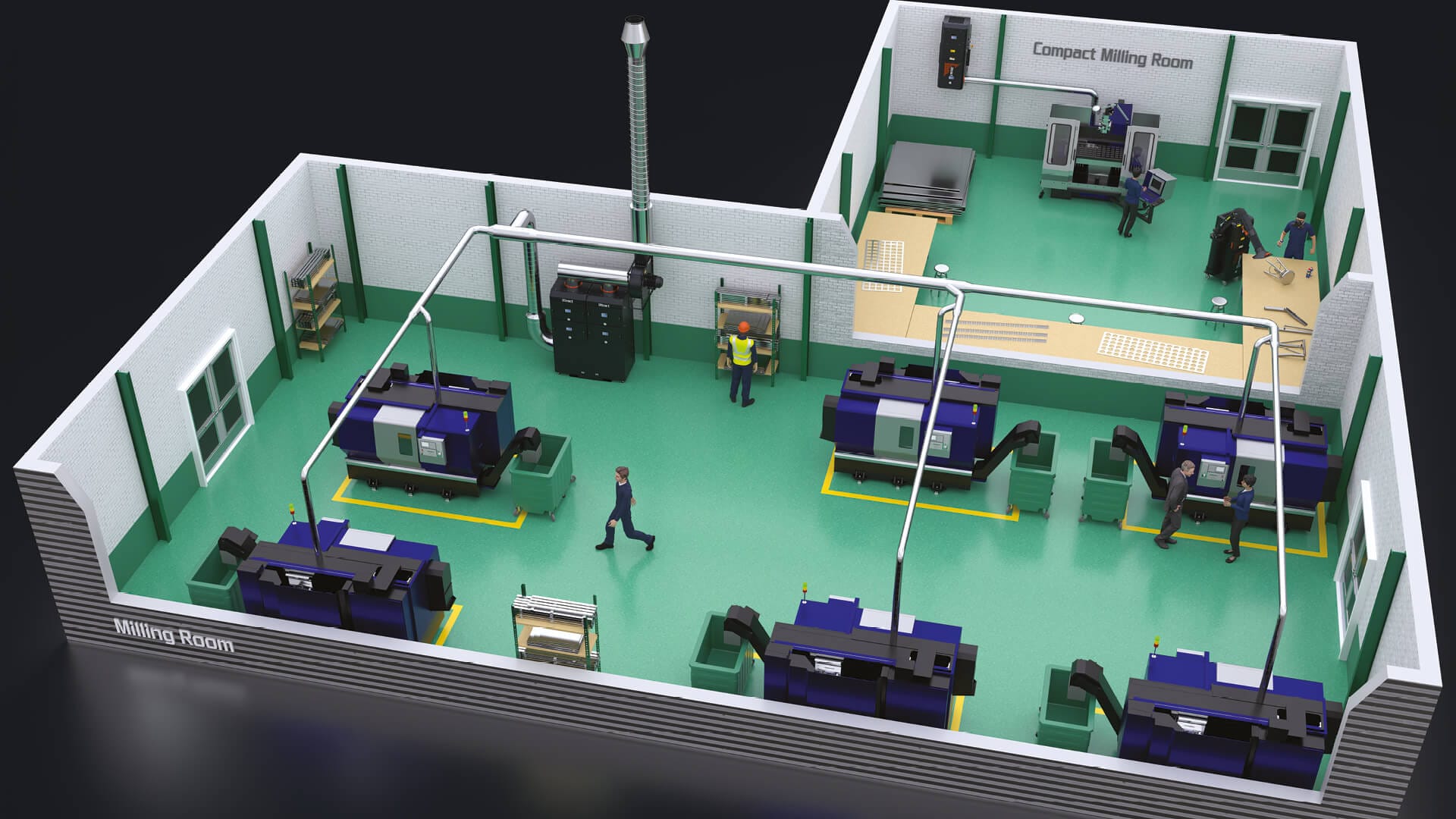
The most reliable way to control oil mist is to reduce it at the source, enclose the process, extract it at an airflow matched to the enclosure, and filter it in stages before the air is discharged or returned to the workshop. Each step supports the others, and the system needs regular testing to keep working.
Fast-spinning tools and pressurised coolant turn metalworking fluid into airborne mist. Left uncontrolled, it drifts through the workshop, coats floors and equipment, and puts operators’ health and your COSHH compliance at risk. This guide explains how oil mist forms, five practical ways to control it, and how iXtract’s oil mist filters fit into a well-designed local exhaust ventilation (LEV) system.
What is oil mist in machining?
Oil mist is a cloud of tiny droplets of cutting oil or coolant suspended in the air. It forms when fluid is flung off a spinning tool or workpiece, sprayed under pressure, or heated until it vaporises and then condenses again as smoke. It is common in turning, milling, drilling and grinding, with both neat oils and water-mix coolants.
Droplet size decides where the mist goes:
- Larger droplets fall out quickly and settle on the machine, the floor and nearby surfaces, which creates slip hazards and extra cleaning.
- Fine droplets and condensed vapour stay airborne, travel across the workshop and are the part most likely to be breathed in.
Much of this mist is invisible, so its effects are easy to underestimate. Beyond the health risk, it leaves residue on electrical equipment, raises maintenance costs and makes the workplace less pleasant for everyone. Employers have a legal duty under COSHH to control exposure to hazardous substances, and metalworking fluid mist falls within that duty.
Five ways to control oil mist
1. Reduce the mist at source
The less mist a process creates, the less the extraction system has to handle. Check that coolant is directed at the cutting zone rather than splashing, that pressure and flow are no higher than the job needs, and that the fluid is kept clean and at the right concentration. Small changes here can noticeably reduce the load on the filter.
2. Enclose the process
A well-fitted enclosure keeps mist in one place and lets extraction work at a lower airflow. Worn seals, gaps and doors left open let mist escape, and no filter can recover mist that never reaches it. Fix the enclosure before blaming the extraction.
3. Extract at the right airflow
Set the airflow from the design of the enclosure or hood, not by guesswork. Too little and mist escapes; too much wastes energy, adds noise and can pull more fluid into the filter. HSE’s guidance on LEV, HSG258, sets out the design information a designer should work from, and the airflow measured at commissioning should be recorded so that later tests have something to compare against.
4. Filter in stages
A staged filter handles different droplet sizes in turn. Coalescing stages join fine droplets into larger drops that drain away, and later stages remove finer mist. A final HEPA stage is worth considering where cleaned air is returned to the workspace or where the finest particles must be removed.
5. Maintain and test
Under COSHH Regulation 9, LEV must be thoroughly examined and tested at least every 14 months. Between tests, check the pressure gauge, replace filters on schedule, confirm that the drain and oil collection are working and look for leaks or damaged ducting. A neglected system loses efficiency quietly, and the first sign is often mist back on the floor.
How iXtract oil mist filters work
All iXtract oil mist filters follow the same staged path:
- Inlet and base. Contaminated air enters at the base, where an integrated primary baffle and a washable mesh pre-filter disperse the air and stop larger oil droplets.
- Oil drainage. Condensed oil collects in the base and either drains through a connected drain (a 1″ BSP connection on the standard units) or is caught in an optional collection canister.
- Coalescing filters. On the standard units the air then moves upward through a primary M6 coalescing cassette filter and a secondary F9 coalescing cassette filter.
- Optional HEPA stage. An H13 HEPA module removes 99.97% of particles as small as 0.3 microns, and clean air leaves from the top of the unit.
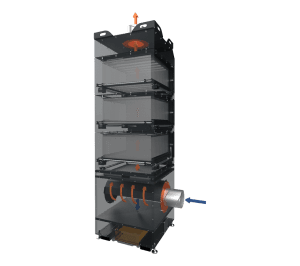
Each unit has a pressure differential gauge to show when filters need changing, and access doors for quick replacement. Every iXtract oil mist unit is designed, built and tested in Britain.
The iXtract oil mist range
Standard oil mist filter units
The standard range covers 2,000 to 16,000 m³/h, with or without an integrated fan. The versions with an integrated fan are all-in-one units that need no external fan.
| Model | Airflow | Inlet | Integrated fan version |
| OMSF-2000 | 2,000 m³/h | 200 mm | OMSF-2000-F with 3 kW fan |
| OMSF-4000 | 4,000 m³/h | 315 mm | OMSF-4000-F with 3 kW fan |
| OMSF-8000 | 8,000 m³/h | 400 mm | OMSF-8000-F with 11 kW fan |
| OMSF-16000 | 16,000 m³/h | 2 × 400 mm | OMSF-16000-F with 2 × 11 kW fans |
Compact oil mist filter units
For a single machine or a small area, the compact range includes a wall-mounted unit and a mobile unit, both with integrated fans. The mobile unit with extraction arm (OMFM-600-MOB-HEPA-EXT) combines a 0.75 kW fan, an airflow of 2,123 m³/h, an H13 HEPA filter, an M6 primary filter and a 5-litre oil tank on castors. The lightweight arm has an airflow damper and interchangeable hoods, so the hood can be placed at the source.
Add-on stages
- HEPA filter modules (HEPA-2000 to HEPA-16000) fit into circular ducting and work alongside an existing LEV system as a final stage.
- Carbon filtration units capture gaseous contaminants where odours or vapours need controlling as well as mist.
Choosing the right unit
The right choice depends on design airflow, the fluid in use and the layout of the site, and a competent LEV designer should confirm it.
| Situation | Worth considering |
|---|---|
| One machine or a small cell | Compact wall-mounted or mobile unit |
| Flexible capture that moves between machines or bench tasks | Compact mobile unit with extraction arm |
| Several machines on a ducted system with an external fan | Standard OMSF unit sized to the total design airflow |
| Ducted system where a ready-to-run package is wanted | OMSF-F unit with integrated fan |
| Cleaned air returned to the workshop, or the finest mist must be removed | Optional HEPA module |
| Existing LEV needs a final filtration stage | HEPA filter module |
| Odours or vapours as well as mist | Carbon filtration unit |
What designers and installers should specify
- The design airflow for each enclosure or hood, and the total for the system, matched to the unit’s rated airflow and inlet size.
- Whether a fan is integrated or supplied separately.
- The drain route and how collected oil will be stored and disposed of.
- Whether a HEPA stage is needed, and the extra height and weight it adds.
- The airflow and pressure readings to record at commissioning, so that thorough examination and testing can compare against them.d
- The data sheet and O&M manual for the chosen model, both available from iXtract.
Frequently asked questions
How do I size an oil mist filter?
Start from the design airflow for the enclosure or hood, then choose a unit whose rated airflow covers it, and confirm the duty point with the manufacturer. iXtract’s standard range runs from 2,000 to 16,000 m³/h, and the team can help with selection.
How often does oil mist extraction need testing?
LEV must be thoroughly examined and tested at least every 14 months under COSHH Regulation 9, following HSE’s HSG258 guidance.
Do I need a HEPA filter on an oil mist unit?
Not always. It depends on your risk assessment and on whether cleaned air is returned to the workplace. The HEPA stage is an option on every iXtract standard unit, so it can be added at specification or later.
Can I add filtration to an existing LEV system?
Yes. iXtract’s HEPA filter modules are designed to fit into circular ducting and work alongside an existing LEV system.
Talk to iXtract
If oil mist is a concern in your workshop or on a project, our team can help you size a system, choose between standard and compact units and request pricing and data sheets.
- Oil mist extraction range
- Standard oil mist filter units
- Oil mist filter units with integrated fan
- Compact oil mist filters
- HEPA filter modules
- Contact us or call +44 (0)1942 409767
Further reading: HSE guidance on local exhaust ventilation.